
The Hewlett Packard Calculator Page
(since April 22, 1997) Last Update: August 31, 2021 -- THE HP REFERENCE
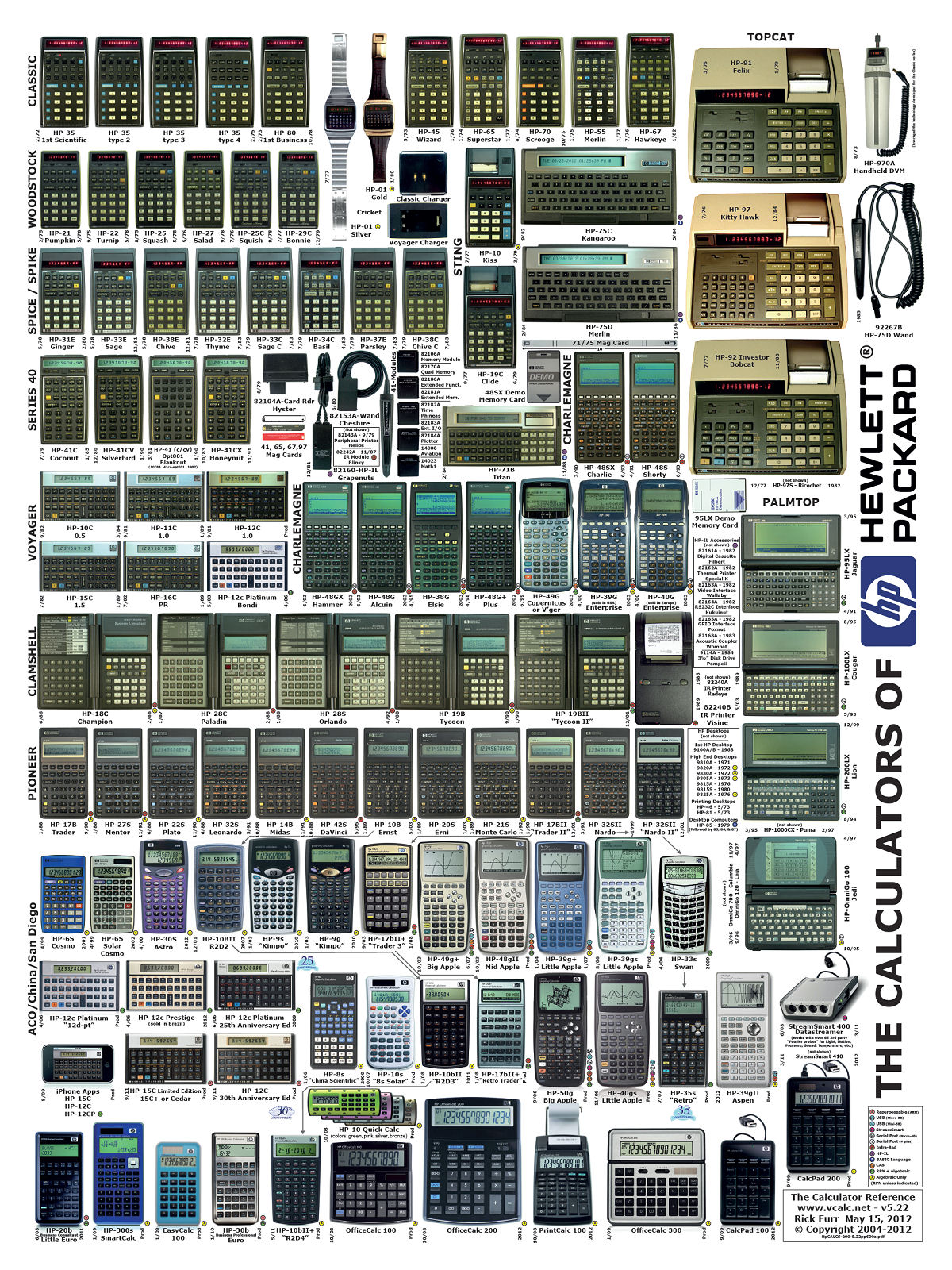
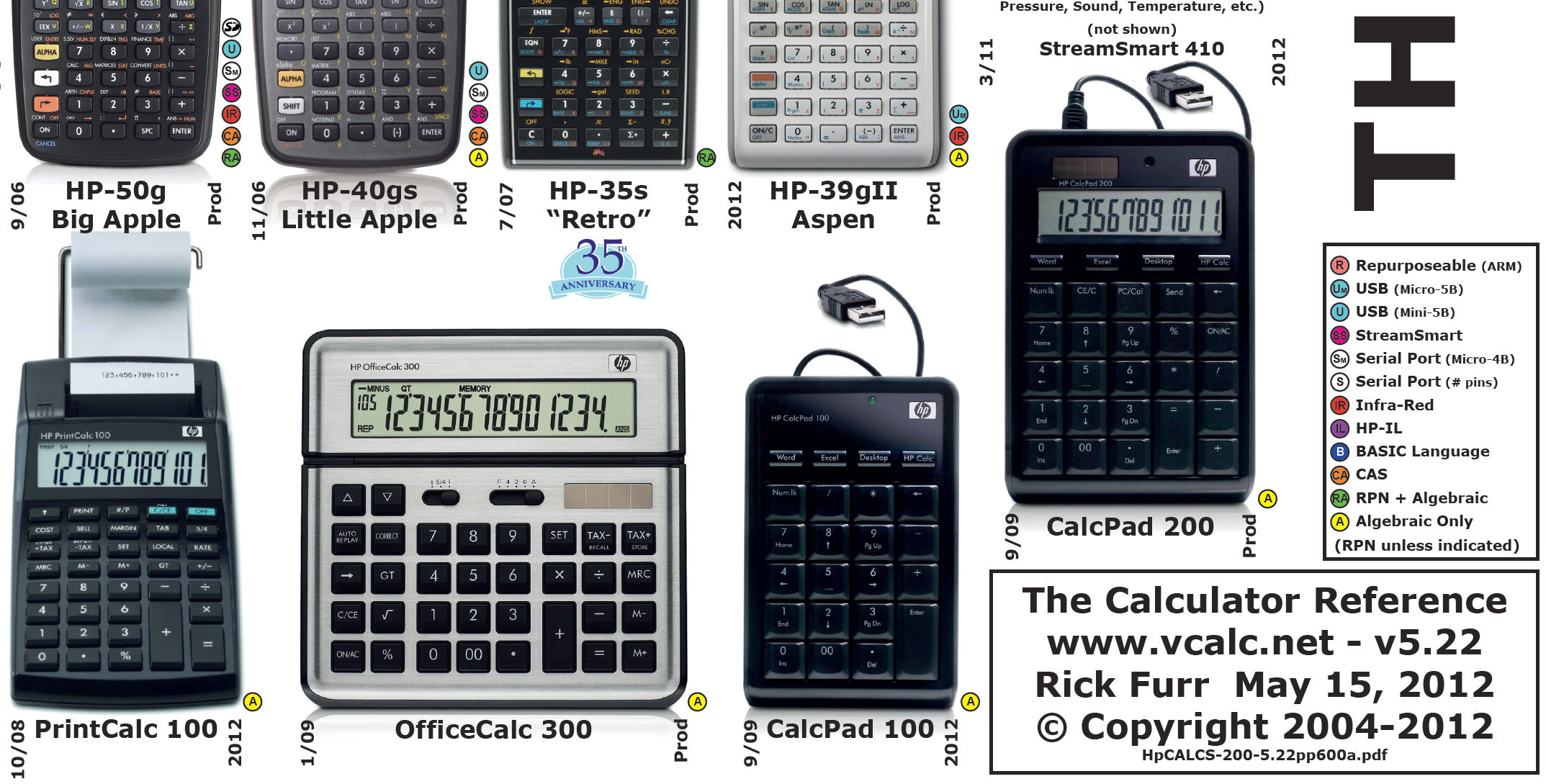
NEW VERSION!After 7 year from the publication of the original HP Calculator poster and over 1 year in the making, I am proud to introduce the Calculators of HP Poster #2 for all HP fans. This poster shows every HP calculator made starting with the famous HP-35. It now includes pictures of 115 HP calculators and 20 perpherals made through 2012. Each calculator is displayed with it's production start and end date, and the project codename. Lots of new information has been added including dates and code names for more of the HP41 accessories, HP-IL devices and printers. Also new for this version is the inclusion of calculator entry modes (RPN/Algebraic/CAS/BASIC) and I/O capability (IR, Serial, StreamSmart, HP-IL, USB). And every calculator on this new poster has been rephotographed with an active display!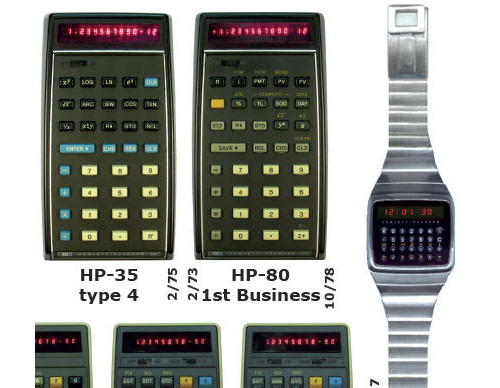 Buyer Feedback!
|
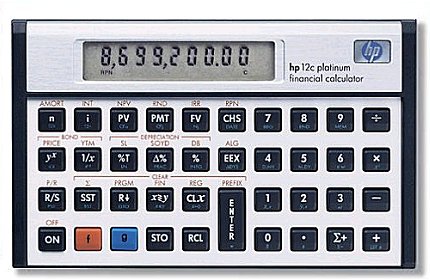
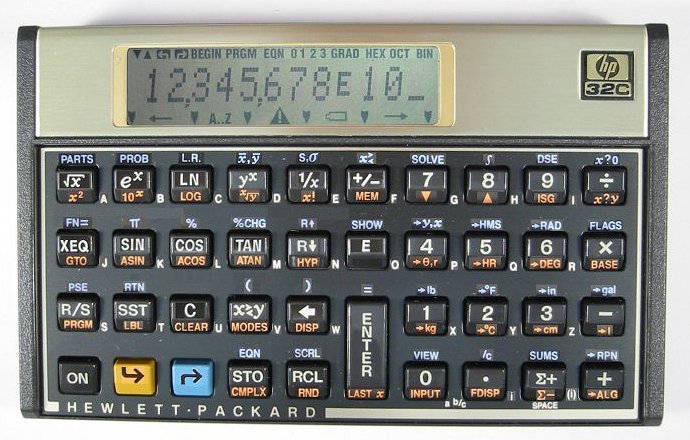
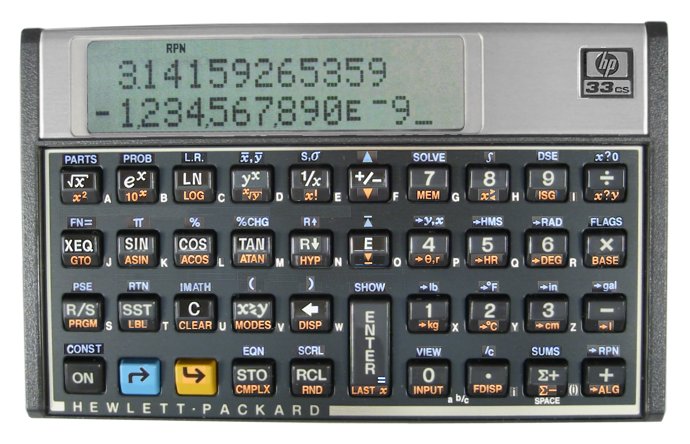
| The HP 12c Platinum is a powerful tool capable of handling the most complex and detailed financial calculations. Users of the HP 12c Platinum will enjoy the flexibility this calculator offers with both RPN and algebraic modes of entry, the increased memory capacity and the more-than 130 built-in functions. Easily calculate loan payments, interest rates and conversions, standard deviation, percent, TVM, NPV, IRR, cash flows, bonds and more. Ideal for real estate, finance, accounting, economics and business work. Permitted for use on the CFP and CFA Certification Exams, and GARP FRM Exam. The Platinum is the first of HP designs to include both modes: ALG (Algebraic) and RPN (Reverse Polish Notation)! Notice the mode selections above the "CHS" and "EEX" keys. | Now if HP would come out with a hybrid of the HP15C and the HP32SII!. Here is a mockup I created in November 2002. Note the "+" key where I envisioned the dual mode capability (click on the pic for a large view). Needless to say I thought RPN was dead when HP discontinued one of my favorite machines, the HP32SII. Then I saw the announcement today (June 2003) of the HP12C Platinum with it's dual Algebraic/RPN modes. Maybe a scientific RPN machine is in the future yet! I don't need a boat anchor [graphing] scientific, I need a good scientific with the convenient foot print of the 12c/15C (Voyager) family that runs RPN. Throw in the dual Algebraic/RPN modes and you've got a win-win solution for both camps! |
|
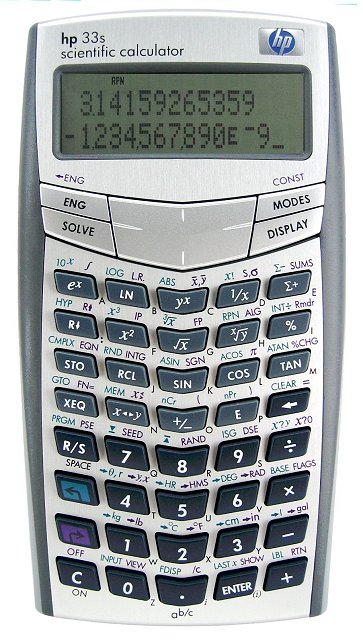
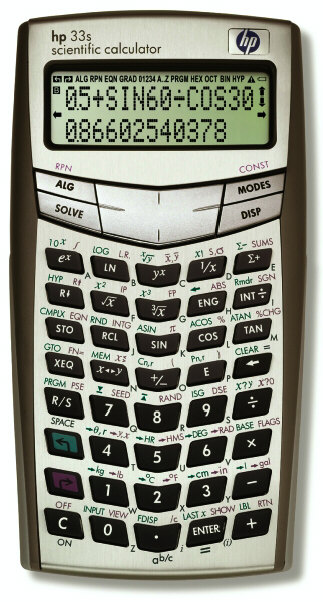
The HP-33s 2-line display scientific calculator is the long awaited replacement for the
HP 32sII RPN Scientific Calculator.
Ideal for engineers, surveyors, college students, scientists and medical professionals.
Accuracy, functionality, dependability. Scientific projects require these vital attributes for success.
The pocket-sized HP-33s scientific programmable calculator delivers them - and more - with features that
include 31KB user memory, your choice of RPN and algebraic data-entry modes, a powerful two-line display,
and the timesaving HP Solve application. Permitted for use on SAT I, SAT II Math IC/IIC, ACT, PSAT/NMSQT,
AP Chemistry/Physics, PLAN, EXPLORE.
Where's the "Enter" key??? Gee this calc must have been designed by somebody with an
Algebraic mind...
HP fans can breathe a shy of releif. The handheld RPN calculator is not dead. The 33s is
a reincarnation of the popular and near perfect 32sII calculator.
Positives: o Retains the functionality of the 33sII calculator. o 2 line alpha-numeric 5x7 dot matrix display. o RPN and Algebraic modes of operation. o Excellent manual. o An eye catching design (too bad engineeres don't care). o 32k of memory (the 32sII had 384 bytes!). o Built in physical constants. o Quotient and Remainder of Division. o Nice leather case (it's a little too thick). Negatives: o Not in the footprint of the Voyager series (11c,12c,15c). o Tiny enter key. o Horrible shift key colors that you can't distinguish between in normal light. o Comma and decimal points need to be larger. o Funky slanted keyboard... actually this is not so bad once you get used to it. o No logical operations (XOR, AND, etc)... build in some of the 16c functionality. o Sub-menu functions that you never need are moved to top keyboard level (32sII - PARTS and PROB menus). o Only 26 labels for 32k of memory. Summary, it's a step down from the 32sII but RPN is still alive. The calculator will be popular and seems to be hopping off the college bookstore shelves. Now HP, repackage it in the Voyager series format!!! Most web sites are posting this picture. Notice the change in the keyboard layout???? |
OK, one more try. Take the great display on the new 33s (with larger comma/decimals), and merge it into to HP-15C package. That's an engineers dream calculator. |
|
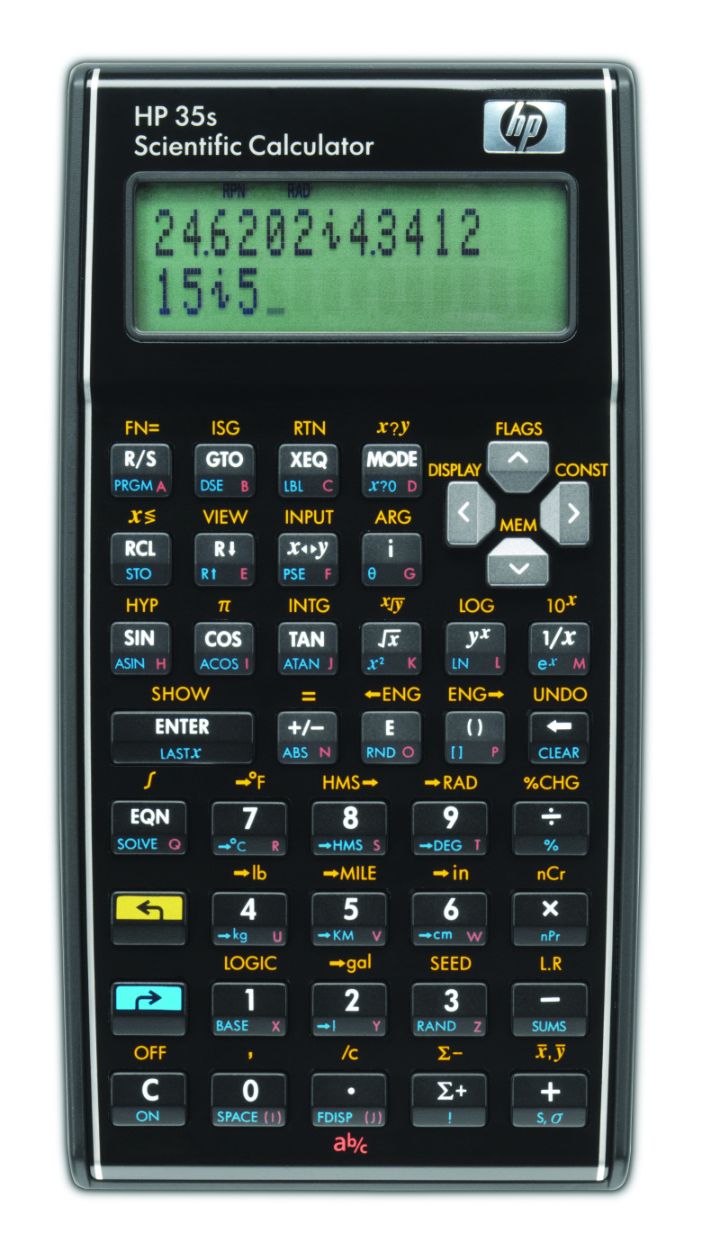
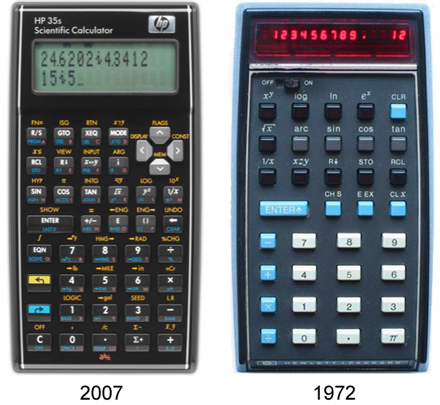
This is the 35th anniversary tribute to the HP-35... A big improvement over the crazy HP-33s!
Overview Get professional performance from HP's ultimate RPN scientific programmable calculator ideal for engineers, surveyors, college students, scientists and medical professionals. Scientific projects require accuracy, functionality and dependability for success. The HP 35s scientific programmable calculator delivers them and more with features that include 30KB user memory, your choice of RPN and algebraic entry-system logic, a convenient two-line display, and the time-saving HP Solve application. Features RPN or algebraic entry-system logic Keystroke programming HP Solve 100 built-in functions Large 2-line display with adjustable contrast Single and two-variable statistics Linear regression and more 30 KB of memory plus 800+ independent storage registers Fraction mode plus fraction-to-decimal conversion 42 built-in physical constants Plus a complete library of unit conversions, inverse functions, cube root, logarithms, exponents, factorials and more Ideal for: Ideal for engineers, surveyors, college students, scientists and medical professionals. Permitted for use on Permitted for use on SAT Reasoning Test SAT Subject Tests in Mathematics Level 1 and Level 2 ACT Mathematics Test PSAT/NMSQT AP Chemistry/Physics PLAN EXPLORE. |
PALO ALTO, Calif., July 12, 2007 HP today unveiled the retro HP 35s Scientific Calculator in commemoration of the original HP-35, the world's first handheld scientific calculator launched 35 years ago. As part of its year-long 35th anniversary celebration of the company's entry in the handheld calculator business, HP also named the winners of its nationwide calculator video contest. The HP 35s pays tribute to its revered lineage with a classic design that is reminiscent of the original HP-35, including protective raised edges so that the calculator rests nicely in the palm of one's hand. The new calculator is also HP's most advanced scientific programmable calculator, featuring ample memory for keystroke programming, equation solving and more than 800 storage registers; 100 built-in functions; and a large, two-line display with adjustable contrast to easily view entries. For greater flexibility, the HP 35s allows users to easily switch between Reverse Polish Notation (RPN), HP's exclusive time-saving input mode, and the traditional algebraic mode. In addition, the HP 35s comes with a premium zippered protective pouch. "With the HP 35s, HP honors the legendary HP-35 scientific calculator, which revolutionized the way engineers and scientists worked and marked the birth of HP's innovative heritage in the handheld calculator market," said Sam Kim, acting general manager, Calculator Division, Personal Systems Group, HP. And today's winning contest videos help share this HP story, showing the new online generation how HP calculators touch people's lives. |
|
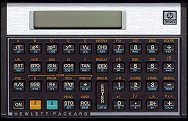
Bring back the HP-15Cby Chris W |
|
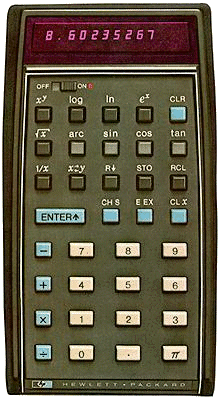
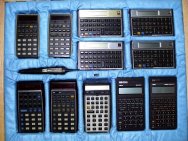
The First and the Last HPs |
|
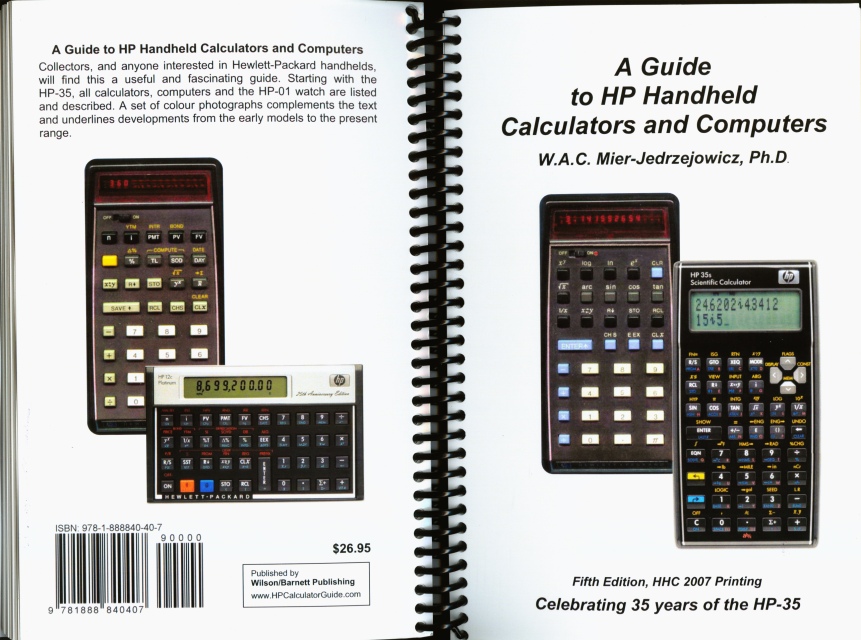
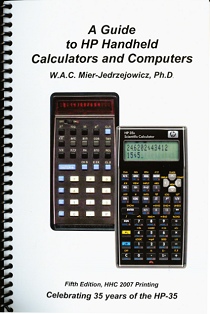
A Guide to HP Handheld Calculators and Computers
|
|
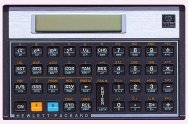
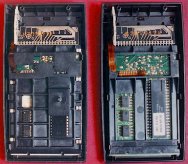
A look inside Hewlett-Packard's HP-11C |
|
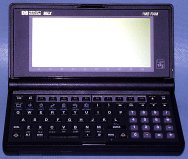
HP-95 PALMTOP: POWER IN A SMALL PACKAGE |

|
Microcode: Electronic Building Blocks For Calculators |

|
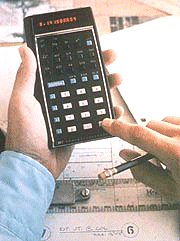
Made in USA...finally! |
|
The HPs |
 |
Hewlett Packard Dates |
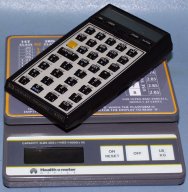 |
Hewlett Packard Weights |
|
30 Series Derivations |
|
This page lists the following:
|
 |
Hewlett Packard ArticlesA Guide to HP Handheld Calculators and Computers |
|
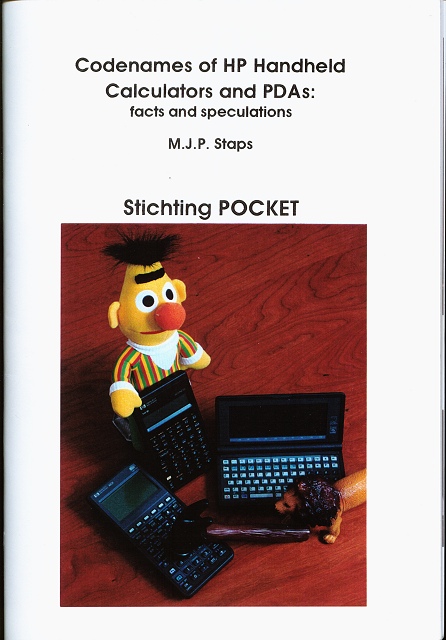
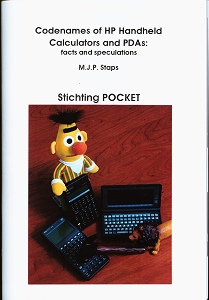
Codenames of HP Handheld Calculators and PDAs:
|